Three days ago, it was the hardback publication day of Alan Bennett’s Two Besides: A Pair of Two Monologues – a duo of monologues written last year by Bennett, that were performed as part of the lockdown series on the BBC in June. The collection features An Ordinary Woman and The Shrine (that was also performed at the Bridge Theatre in September – see my review here). I have already seen these both on screen, but wanted a copy of my own… pretty much just to sit beside my battered, second hand copy of Bennett’s first collection of Talking Heads.
The cover of ‘Two Besides: A Pair of Talking Heads’
However, despite having already seen these on screen and on stage and with a big thanks to my ever-procrastinating personality, I decided to reread these pieces… but not before reading the introduction from Nicholas Hytner who was involved with the new collection.
Hytner describes the process of organising a series like this in a short amount of time and whilst still following social distancing measures. He writes about Zoom calls to make up artists and actors, phoning Alan Bennett (who has no laptop and still relies on his infamous typewriter) and the process of acquiring over 50 different costumes through eBay. These are just a few of the problems production had to face!
Reading this introduction is an eye-opener for anyone, and shows how strong and dedicated the arts industry is despite major setbacks (that mostly being the Tories – thanks for that). The whole planning process and the way it was made is honestly incredible – the production team really do deserve some credit.
The inside cover…
The publication of this text is really amazing, but what prompted this blog was Hytner’s last remarks.
As the Artistic Director of the Bridge Theatre, as well as director of a handful of the monologues, he highlights the reality of risks towards the survival of the theatre – something deeply personal and important to everybody involved in Talking Heads, but also to the people reading this book. The theatre and the arts are embedded in the everyday, and we can’t escape the importance of it!
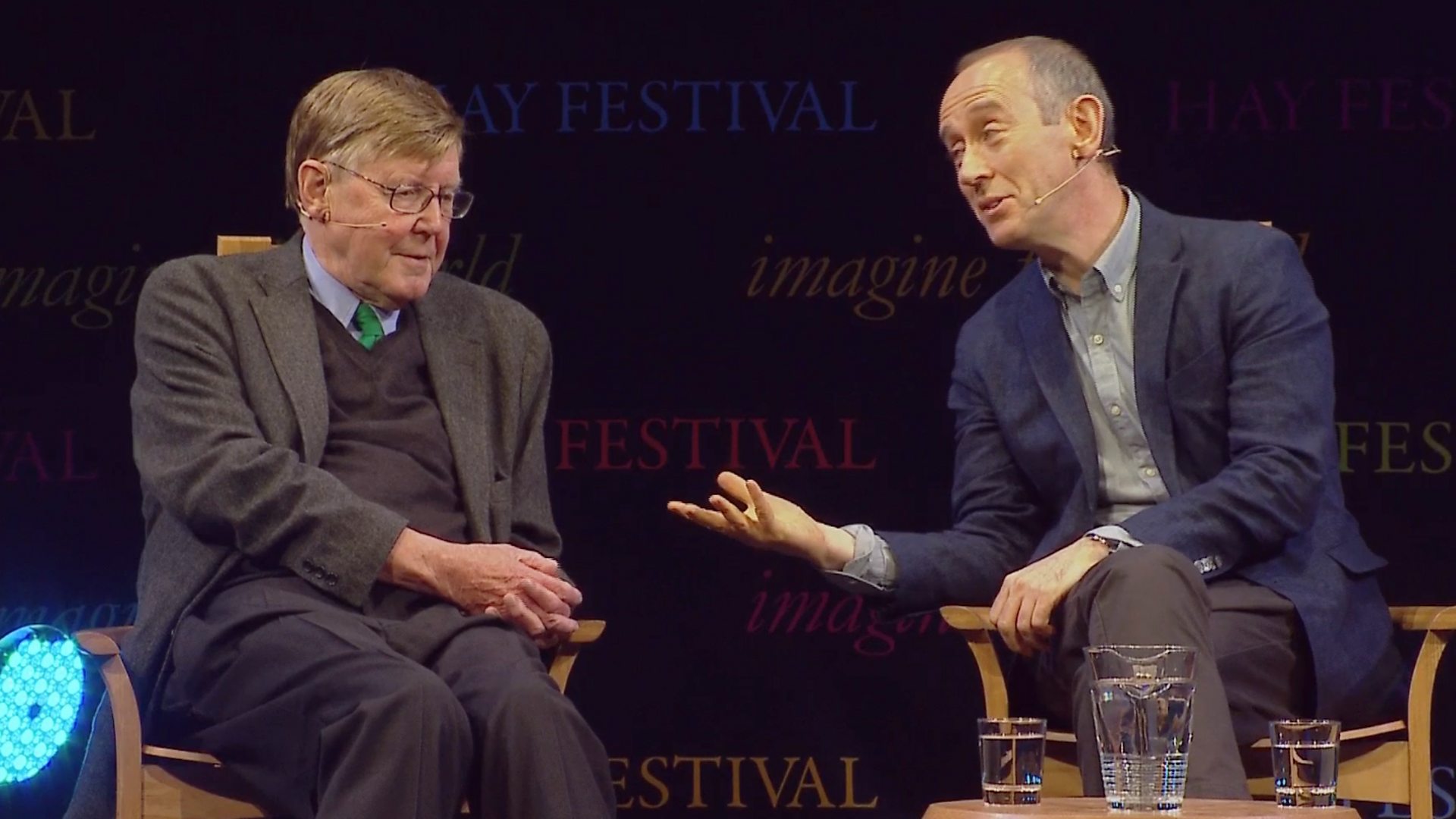
Alan Bennett and Sir Nicholas Hytner: Source – BBC (2016)
In his final passage, I feel a sense of hope in Hytner’s words. He is positive about making it through this difficult time and it is encouraging, to think that one day we will return to a time where arts aren’t seen purely as a hobby and politics aren’t intertwined or put up against the freedom of creativity and live performance.
His last thoughts read:
‘… I hope that somebody will one day pick up this book in a second-hand bookshop (assuming they still exist), leaf through the introduction, and vaguely remember that there was once a terrible virus that brought nearly everything to a halt. And I hope she buys the book, because two short plays by Alan Bennett will always be worth having. And then she joins her friends in the bar next door, and together they walk through the crowded streets to the theatre.’
To kick off my ‘Thespian Thoughts’ series, I thought that I would blog about what it was like to experience the theatre with new kind of set up, thanks to the coronavirus pandemic. Last week, after having not stepped into a theatre for 195 days, I finally went to see my first socially distanced live performance. I travelled down to London’s Bridge Theatre, and got to see how the theatre environment had completely changed… it was different, exciting and unexpectedly… quite emotional!
Outside of the Bridge Theatre – located on Potters Field Park
The Bridge Theatre is one of the first theatres to reopen its doors to the public, and begin showcasing works in a socially distanced manner – they have adapted their flexible auditorium, converting it into a space with 250 socially distanced seats.
For the past few weeks, the theatre has been hosting a collection of monologues and one-character plays, performed (and in some cases, written) by an array of Britain’s finest acting talent. The repertoire kicked off with Beat the Devil, written by David Hare and performed by Ralph Fiennes. This piece has already received high praise and four-star reviews. Currently underway are Alan Bennett’s Talking Heads – they were seen on TV earlier this year, having been filmed and produced during the pandemic, by the BBC. Eight of the twelve monologues are being performed in double-bills at the Bridge Theatre, including one of Bennett’s new pieces, and some of his most prestigious work. The cast include: Monica Dolan, Tamsin Greig, Lesley Manville, Lucian Msamati, Maxine Peake, Rochenda Sandall, Kristin Scott Thomas and Imelda Staunton. Later on, in the season, the Bridge will host more distinguished monologues, including Quarter Life Crisis – written and performed by Yolanda Mercy. As well as, Nine Lives, written by poet, Zodwa Nyoni and performed by Lladel Bryant.
The Bridge Theatre’s Repertoire
Of course, in order to showcase such works, the Bridge Theatre have worked hard to enforce social distancing measures and enable people to finally get back into theatre. Here are some notable changes that have been made:
The first change is have staggered times of entering the theatre. This helps to reduce crowding, inside and outside of the building, as well as allowing people to meet the ‘two-metre’ rule at all times. When booking tickets, you are allocated a certain time to arrive. Subsequently, this allocated time also determines what time you enter the auditorium.
The Bridge Theatre’s Foyer
Another smaller, yet very efficient change, is to allow audience members to pre-book drinks for before and during the performance – on the morning of your performance, the Bridge text message you with a link to do this. This message also reminds you of your allocated time, the door which you should enter when going into the auditorium and your seat numbers. This isn’t a huge change, but I thought that it was really effective and helped you prepare for an overall smoother and less stressful visit.
Upon arrival, staff also explained how to maintain social distancing with their one-way system, about the required temperature check and when/where to wear your mask.
Then, onto the actual performance…
Inside the Auditorium
At all times, you are asked to wear a mask when in the auditorium – understandable, especially as the performers are not wearing PPE. Then, after being called, you can finally go and find your seats. There were a few stewards around the entrances and in front of the stage, reminding people to keep their masks on.
The auditorium was really strange to see!
Hundreds of seats were missing. Not many people were there and it was a lot quieter than your usual theatre.
There were seats in couples, groups of three and some single seats scattered around the space, all maintaining a safe two metres.
After finding my single seat (yes… theatre is just as fun when you are on your own), it was such a surreal experience. For me, it felt amazing to finally be back in this kind of environment and supporting an industry that is suffering immensely due to the pandemic – it gave me a tiny glimpse of hope that the arts sector would make it out on the other side… but, who knows, I may have just suddenly been feeling optimistic because I was sitting in front of a stage.
Also, watching something like Talking Heads (I saw the double-bill of ‘The Shrine’ and ‘Bed Among the Lentils’, performed by Monica Dolan and Lesley Manville – a review will be coming soon), as something which I had both read and watched during lockdown boredom and for dissertation research, everything suddenly felt more real, and it was crazy to have these incredible piece’s being performed in front of me. I think by the time the Talking Heads theme tune began… I was pretty excited!
Of course, there were some downfalls of having to experience the theatre like this. It was less immersive and at points, it was hard to connect with the storylines and the performances, because you were so overwhelmed with this newly founded way of watching theatre. Also, the theatre was still quite bare. Perhaps, naively, I thought more people would be bursting to watch something live (I know, I was!), so perhaps there is still some uncertainty and anxiety about coming back to experience the arts.
There was definitely an added pressure to these performances – for both the audience, to maintain public safety, but also on the performers. I think the actors felt an immense pressure, but also gratitude, with being involved in any kind of live performance – especially when performing such renowned pieces of writing.
What I didn’t expect was the emotion throughout the room. Dolan and Manville were both extremely raw with performing their emotions – their characters were either attempting to overcome grief, or alcoholism and strenuous relationships. I feel that the emotion was heightened given our surroundings and with the themes the pieces both explored, and overall they both gave such heartwarming and beautiful performances. I am certain that everybody at the Bridge Theatre, during every laugh, cry and deep thought, were absolutely thrilled to be able to see such exceptional performances.
Overall, I would highly commend the Bridge Theatre at how they are enabling safe access to the theatre. Every moment you are in the foyer, auditorium or outside of the building, you feel safe. I would definitely recommend going to see a performance at the Bridge, just to attempt to get back into any kind of live performance whatsoever – especially as we need to begin to appreciate such a fragile industry and support it any way we can! These pieces were new and restorative, and after seven months without any in-person theatre… it was absolutely something I needed!
(I have inserted links to the Bridge Theatre and its repertoire throughout the blog – make sure you check them out!)
After writing all about my ‘Pandemic Ponderings’ back in May, I have decided to begin a completely new series of blogs, called ‘Thespian Thoughts’.
The word thespian, as a noun, can mean actor and as an adjective can relate to drama and theatre in general, so you guessed it… for the next few weeks/months this blog is purely dedicated to the theatre world (and mostly how I am coping without it!).
This idea came to me a few weeks ago, but then after my first socially distanced theatre trip, a few days ago, I thought that I should actually give it a go! I’m hoping to get back into the swing of writing (after such a loooooong break) and this blog gives me the space to rave and rant as much as I like! Expect reviews, even more overdue reviews from online theatre, and some interesting concepts and ideas that I come across when researching for my dissertation.
Today, I have been reading through some old poetry notes and I wanted to share one of my favourite Shakespearean sonnets. I really love it… plus I have no time to blog properly at the moment. I absolutely love the relationships that Shakespeare presents in his collection of sonnets… controversial for his time, yet really unique! I have posted this sonnet before in my ‘Eureka Literature’ blog post, so if you want to read more about it, then check it out there!
Sonnet 124 by William Shakespeare
If my dear love were but the child of state,
It might for fortune’s bastard be unfathered,
As subject to Times love or to Times hate,
Weeds among weeds, or flowers with flowers gathered.
No, it was builded far from accident;
It suffers not in smiling pomp, nor falls
Under the blow of thralled discontent,
Whereto th’inviting time our fashion calls,
It fears not policy, that heretic,
Which works on leases of short-number’d hours,
But all alone stands hugely politic,
That it nor grows with heat, nor drowns with showers,
To this I witness call the fools of time,
Which die for goodness, who have lived for crime.
I read Molière in my first year of university in my theatre module. I was instantly hooked when reading The Misanthrope… and then went on to read Tartuffe, Les Femmes Savantes and Le Malade Imaginaire. I think that I liked his writing mostly because it was French literature, and having studied French for over eight years, I appreciated the craftsmanship and beauty of the language. It was also ridiculously witty, and his characters were so outrageous, that the memory of them just stuck very well. I also loved that we began focusing on something other than English Literature, and not just the theatrical tragedies of Shakespeare and Marlowe.
Here are a few quotes that I enjoy:
‘Of all follies there is none greater than wanting to make the world a better place.’
Molière
‘The greater the obstacle, the more glory in overcoming it.’
Molière
‘It infuriates me to be wrong when I know I’m right.’
As deadlines approach and I have no willpower to write anything that screams: creative, analytical or interesting, I have decided to blog simple quotes from famous writers and pieces of literature. For my viewing millions…
Today, I found an old F. Scott Fitzgerald quote, that I made a few years ago. It fell out of my A3 sketch book, begging to be featured on my blog. Et voila!
The painting is by Otto Scholderer, and is called Young Girl Reading (1883). It is was tweeted in relation to Mary Wollstonecraft and Mary Shelley, saying:
READ ‘A VINDICATION OF THE RIGHTS OF WOMAN’!
I really liked this painting, and thought that it goes very well with Mary Wollstonecraft’s arguments. I first read ‘A Vindication of the Rights of Woman’ when I was 17, for my A-Level English coursework. I though it was bold, commanding and extremely persuasive. Also, the idea that the Godwin/Wollstonecrafts were this radical and innovative family, was pretty cool… and made producing draft-after-draft of coursework, on Frankenstein, somehow more bearable!
Here are a few quotes from ‘A Vindication of the Right’s of Woman’, that are well known:
“I do not wish them [women] to have power over men; but over themselves.”
Mary Wollstonecraft
“There must be more equality established in society, or morality will never gain ground, and this virtuous equality will not rest firmly even when founded on a rock, if one half of mankind be chained to its bottom by fate, for they will be continually undermining it through ignorance or pride”
Mary Wollstonecraft
“It is justice, not charity, that is wanting in the world!”
Mary Wollstonecraft
I would definitely recommend reading this – if you are a student trying to understand the Shelley’s lifestyle, or grasp the concept of Romanticism. Wollstonecraft is also a hugely influential figure, in regards to Feminism. Feminists everywhere… she was THE proto-feminist, and wrote so amazingly!
After venturing around the local park today, it made me miss the London green spaces – especially Hampstead Heath, which is quite close to where I am in London. Looking through old Heath pictures, it made me think of Keats and some of his poetry.
Hampstead Heath
This is one of my favourite poems. Often overshadowed by his never-ending amount of odes, but just as lovely.
Bright Star by John Keats
Bright star, would I were stedfast as thou art— Not in lone splendour hung aloft the night And watching, with eternal lids apart, Like nature’s patient, sleepless Eremite, The moving waters at their priestlike task Of pure ablution round earth’s human shores, Or gazing on the new soft-fallen mask Of snow upon the mountains and the moors— No—yet still stedfast, still unchangeable, Pillow’d upon my fair love’s ripening breast, To feel for ever its soft fall and swell, Awake for ever in a sweet unrest, Still, still to hear her tender-taken breath, And so live ever—or else swoon to death.
As it is almost midnight, I thought I had better write a short blog! Today has been full of procrastination, rereading books I don’t need to read, and starting to brainstorm a play idea… I know, madness!
But yesterday, I started to talk to somebody about Ulysses and thought it may make a good, quick blog post.
I read Ulysses about six months ago – it was a battle and took me around five months to read it entirely including making annotations and going over the top with sticky notes . But I finally conquered it and it is the best ice-breaker/conversation opener that I have going. Plus, if you have read Ulysses then you definitely deserve to boast about it!
My friend asked me if I knew that ‘strange quote about hair’ in Ulysses, and despite it being almost 1, 000 pages long, I knew exactly what he was talking about! So here it ,is one of my favourite quotes from the book:
‘Her wavyavyeavyheavyeavyevyevyhair un comb:’d. Yet too much happy bores. He stretched more, more. Are you not happy in your? Twang. It snapped. Jingle into Dorset street.’
Ulysses, James Joyce
Thank you, James Joyce for hurting both my brain and eyes when reading a single word… ahhh Modernism!




 Oh! You Little Things