Reviews · Theatre · Thespian Thoughts

Talking Heads Live: ‘Bed Among the Lentils’ Review

Up next in my ‘Thespian Thoughts’ series, is my review of the second monologue that I saw at the Bridge Theatre.

After a quick change of the set – the sink and kettle are removed, and an array of chairs added – we are graced with another one of Alan Bennett’s monologues, and this time it is Bed Among the Lentils. This piece is legendary within Bennett’s repertoire, known for previously having been performed by Dame Maggie Smith in 1988, on the BBC. However, this time round, the piece is being performed by Lesley Manville… who takes on the challenge and definitely wows the audience!

The Bridge Theatre’s Repertoire of Plays

In Bed Among the Lentils, we meet Susan. She is a vicar’s wife… although even to label her as that is tricky. I got the sense that she doesn’t like to feel owned by her husband, plus she pretty much admits that she doesn’t believe in God. Susan talks about her life – it sounds dull and boring, unadventurous and her life is generally confined to the church.

However, eventually Susan begins to move away from her role as the stereotypical vicar’s wife – she skives from evening prayer, doesn’t care much care for the flower arranging and absolutely despises the clergy full of her husband’s faithful followers. Instead, she begins venturing into Leeds, where during her dalliances, she discovers a small corner shop owned by a young man, whom she refers to as Mr. Ramesh. Soon enough, after every inconvenience and every snide comment from Mrs. Belcher or Mrs. Frobisher, she finally snaps… and her relationship with Mr. Ramesh becomes… intimate. Good for Susan, I say!
REVIEW: Bed Among The Lentils, Talking Heads, BBC iPlayer
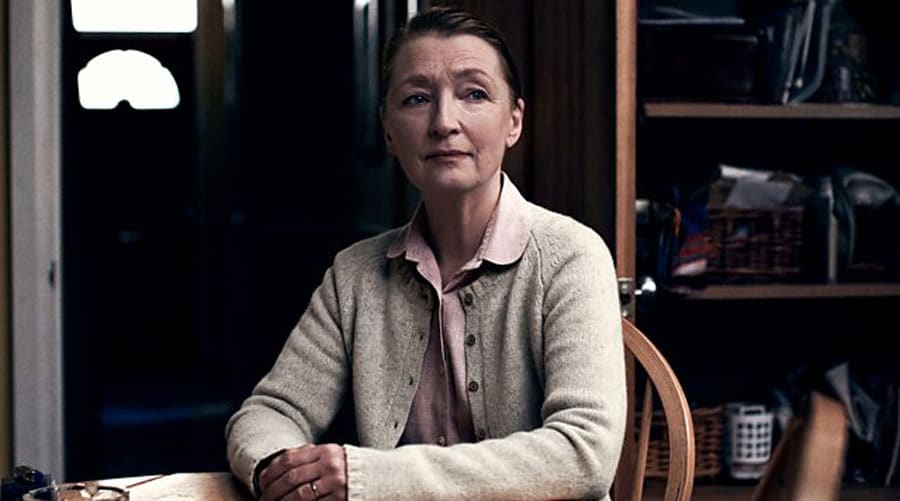
Lesley Manville as Susan, in ‘Bed Among the Lentils’

But that is not the whole story…

Throughout the entire piece, you get a glimpse of a wine bottle or hear a clink of something from a carrier bag and during her time with Mr. Ramesh, it is revealed that she is an alcoholic. Not only does Susan battle with her commitment to the church, but also with her commitment to the bottle. Luckily, her guardian angel, Mr. Ramesh convinces her to seek help – which she does. By the end of the piece, we hear of Susan’s AA meetings. Mr. Ramesh has travelled back to India and her husband is taking all the credit for helping his poor alcoholic of a wife. I can’t help but feel sorry for Susan – she is trapped, unhappy and her spark of adventure is over. She is back at where her story started – in an uncomfortable marriage although this time, she is a bit more sober.

Lesley Manville captured Susan extremely well in this performance – she really convinced the audience that Susan was a timid, plain old women who pretty much served no higher purpose other than her husband. At the same time, she also made sure that the comic sections and taboo parts (like sleeping in a store room with Mr. Ramesh…oops), were strong and heart-warming for the audience. Also, Manville moved around the set effortlessly (her monologue featured more costume changes and intervals where the set was altered) and managed to keep the audience intrigued, despite the background action. In particular, I think Manville portrayed Susan’s calm exterior persona very well, but then was able to relinquish her inner rage as well. The sections which featured pure irritation and a sense of entrapment were really strong.

Without a doubt, the monologue/one-character play form is so brilliant here. We get to see two sides to Susan – the one society sees and her actual personality. Bennett captures this inner conflict so well through his language, sequencing of events and the digressions Susan makes. Especially, with this performance, Manville heightens the emotion really well and the audience clearly see this infuriating division of the self.

(This monologue was the second of a double-bill – the first being The Shrine. If you would like to read my piece on The Shrine, performed by Monica Dolan, then you can click here.)

Reviews · Theatre · Thespian Thoughts

Talking Heads Live: ‘The Shrine’ Review

The Shrine was the first of eight Alan Bennett’s monologues to be performed live, at London’s Bridge Theatre. This piece is one of Bennett’s newly written monologues, which was first seen on the BBC during lockdown, along with An Ordinary Woman – however, The Shrine is the only one of the two being performed. The one-character play has been paired with Bed Among the Lentils, and is the first of four double-bills being performed in the Bridge’s socially distanced auditorium. This double-bill is still being performed, for the next week (click here for more information).

The Bridge Theatre’s Repertoire of Plays

Monica Dolan took to the role of Lorna, a recently widowed woman, who is grieving over the loss of her husband, Clifford. After being involved in a motorcycling accident, she visits the spot where he was killed. She becomes highly invested in this place, building her own seat from things she found in the garage and imagining which tree he had hit. She makes sure to preserve this ‘death place’ – making it into a shrine of some sort. After weeks of obsessing with this spot, run-ins with the police and even a motorbiking Reverend passing by, she comes across a woman leaving some flowers. She claims that she knew ‘Cliff’, a high adrenaline junkie, whom she used to share a bacon and egg sandwich with. For Lorna, Clifford had been the everyday husband, who used his motorcycle to go bird watching, and ate the mozzarella, avocado and tomato sandwiches she made for him. She can’t help feeling saddened at not knowing who Cliff really was…

By the end of the piece, Lorna tries to move on, accepting that her husband may not have been all that he seemed to be – that he had this other identity and it was okay. She makes his helmets into hanging baskets for the garden, and leaves the audience feeling sorry for her. The ending, despite being criticised as anti-climactic, I think really sums up the uncertainty of life, the accidents which can involuntarily happen and the mystery of people we meet along the way.  

Having moved from screen to stage, I think the live performance of The Shrine comes across as more comic that disastrous and serious in tone – Dolan received some really heart-felt laughter during her performance. Lines such as ‘the sheep… they know me now’ and when responding to whether she wanted counselling, Lorna replies ‘who does that, the RAC?’ were just some of the many stand-out lines of Bennett’s monologue.

I think it definitely felt more comfortable laughing with everybody when the piece is being performed live. Sometimes when a piece is so laden with emotion, you don’t always know when it’s appropriate to laugh – being with others definitely normalised the situation a bit more. Also, arguably, this production was a lot less dark than the BBC production, and I think this highlights that grief can come in many ways and trigger different reactions – even comic ones! At one point, Lorna dresses in a bright, orange hi vis, beside the shrine and kneels with the hope people will notice the space. Lorna’s way of connecting and understanding Clifford’s death is not appreciated by others, but I think the comic value can almost bring us back to see the humanity of Lorna and that her reactions are valid. By the end, perhaps Dolan’s tone is more optimistic than that on screen.

Dolan is excellent in this role – emotional, heart wrenching, and performs the whole things with an excellent Yorkshire accent! She had every audience member enthralled by her performance, even during the intervals of the Talking Heads music (composed by George Fenton) and the typical Bennett tea-making scenes. Dolan hit all the laughs in the right place, whilst still maintaining an extreme amount of emotion and composure. Most significantly, Dolan illustrates that grief is not always the same for everybody and that Lorna’s definitely ‘wasn’t typical’. This performance was a perfect way to kick off the Bennett repertoire at the Bridge, addressing moving and emotional themes like grief and death. Monica Dolan really brought so much emotion and energy into this performance.

Thespian Thoughts

Socially Distanced Theatre-ing

To kick off my ‘Thespian Thoughts’ series, I thought that I would blog about what it was like to experience the theatre with new kind of set up, thanks to the coronavirus pandemic. Last week, after having not stepped into a theatre for 195 days, I finally went to see my first socially distanced live performance. I travelled down to London’s Bridge Theatre, and got to see how the theatre environment had completely changed… it was different, exciting and unexpectedly… quite emotional!

Outside of the Bridge Theatre – located on Potters Field Park

The Bridge Theatre is one of the first theatres to reopen its doors to the public, and begin showcasing works in a socially distanced manner – they have adapted their flexible auditorium, converting it into a space with 250 socially distanced seats.

For the past few weeks, the theatre has been hosting a collection of monologues and one-character plays, performed (and in some cases, written) by an array of Britain’s finest acting talent. The repertoire kicked off with Beat the Devil, written by David Hare and performed by Ralph Fiennes. This piece has already received high praise and four-star reviews. Currently underway are Alan Bennett’s Talking Headsthey were seen on TV earlier this year, having been filmed and produced during the pandemic, by the BBC. Eight of the twelve monologues are being performed in double-bills at the Bridge Theatre, including one of Bennett’s new pieces, and some of his most prestigious work. The cast include: Monica Dolan, Tamsin Greig, Lesley Manville, Lucian Msamati, Maxine Peake, Rochenda Sandall, Kristin Scott Thomas and Imelda Staunton. Later on, in the season, the Bridge will host more distinguished monologues, including Quarter Life Crisiswritten and performed by Yolanda Mercy. As well as, Nine Lives, written by poet, Zodwa Nyoni and performed by Lladel Bryant.

The Bridge Theatre’s Repertoire

Of course, in order to showcase such works, the Bridge Theatre have worked hard to enforce social distancing measures and enable people to finally get back into theatre. Here are some notable changes that have been made:

The first change is have staggered times of entering the theatre. This helps to reduce crowding, inside and outside of the building, as well as allowing people to meet the ‘two-metre’ rule at all times. When booking tickets, you are allocated a certain time to arrive. Subsequently, this allocated time also determines what time you enter the auditorium.

The Bridge Theatre’s Foyer

Another smaller, yet very efficient change, is to allow audience members to pre-book drinks for before and during the performance – on the morning of your performance, the Bridge text message you with a link to do this. This message also reminds you of your allocated time, the door which you should enter when going into the auditorium and your seat numbers. This isn’t a huge change, but I thought that it was really effective and helped you prepare for an overall smoother and less stressful visit.

Upon arrival, staff also explained how to maintain social distancing with their one-way system, about the required temperature check and when/where to wear your mask.

Then, onto the actual performance…

Inside the Auditorium

At all times, you are asked to wear a mask when in the auditorium – understandable, especially as the performers are not wearing PPE. Then, after being called, you can finally go and find your seats. There were a few stewards around the entrances and in front of the stage, reminding people to keep their masks on.

The auditorium was really strange to see!

Hundreds of seats were missing. Not many people were there and it was a lot quieter than your usual theatre.

There were seats in couples, groups of three and some single seats scattered around the space, all maintaining a safe two metres.

After finding my single seat (yes… theatre is just as fun when you are on your own), it was such a surreal experience. For me, it felt amazing to finally be back in this kind of environment and supporting an industry that is suffering immensely due to the pandemic – it gave me a tiny glimpse of hope that the arts sector would make it out on the other side… but, who knows, I may have just suddenly been feeling optimistic because I was sitting in front of a stage.

Also, watching something like Talking Heads (I saw the double-bill of ‘The Shrine’ and ‘Bed Among the Lentils’, performed by Monica Dolan and Lesley Manville – a review will be coming soon), as something which I had both read and watched during lockdown boredom and for dissertation research, everything suddenly felt more real, and it was crazy to have these incredible piece’s being performed in front of me. I think by the time the Talking Heads theme tune began… I was pretty excited!

Of course, there were some downfalls of having to experience the theatre like this. It was less immersive and at points, it was hard to connect with the storylines and the performances, because you were so overwhelmed with this newly founded way of watching theatre. Also, the theatre was still quite bare. Perhaps, naively, I thought more people would be bursting to watch something live (I know, I was!), so perhaps there is still some uncertainty and anxiety about coming back to experience the arts.

There was definitely an added pressure to these performances – for both the audience, to maintain public safety, but also on the performers. I think the actors felt an immense pressure, but also gratitude, with being involved in any kind of live performance – especially when performing such renowned pieces of writing.

What I didn’t expect was the emotion throughout the room. Dolan and Manville were both extremely raw with performing their emotions – their characters were either attempting to overcome grief, or alcoholism and strenuous relationships. I feel that the emotion was heightened given our surroundings and with the themes the pieces both explored, and overall they both gave such heartwarming and beautiful performances. I am certain that everybody at the Bridge Theatre, during every laugh, cry and deep thought, were absolutely thrilled to be able to see such exceptional performances.

Overall, I would highly commend the Bridge Theatre at how they are enabling safe access to the theatre. Every moment you are in the foyer, auditorium or outside of the building, you feel safe. I would definitely recommend going to see a performance at the Bridge, just to attempt to get back into any kind of live performance whatsoever – especially as we need to begin to appreciate such a fragile industry and support it any way we can! These pieces were new and restorative, and after seven months without any in-person theatre… it was absolutely something I needed!

(I have inserted links to the Bridge Theatre and its repertoire throughout the blog – make sure you check them out!)

Thespian Thoughts

Thespian Thoughts

Oh no… she’s starting a new blog series…

Photo by Pixabay on Pexels.com

After writing all about my ‘Pandemic Ponderings’ back in May, I have decided to begin a completely new series of blogs, called ‘Thespian Thoughts’.

The word thespian, as a noun, can mean actor and as an adjective can relate to drama and theatre in general, so you guessed it… for the next few weeks/months this blog is purely dedicated to the theatre world (and mostly how I am coping without it!).

This idea came to me a few weeks ago, but then after my first socially distanced theatre trip, a few days ago, I thought that I should actually give it a go! I’m hoping to get back into the swing of writing (after such a loooooong break) and this blog gives me the space to rave and rant as much as I like! Expect reviews, even more overdue reviews from online theatre, and some interesting concepts and ideas that I come across when researching for my dissertation.

Wish me luck…